In CNC machining, people often focus on the obvious factors that influence productivity: machine performance, cutting tools, programming quality, and operator skill. All of these matter, but one factor is often overlooked until it becomes a problem—workholding. A shop may invest heavily in advanced machinery and high-quality tooling, only to discover that inconsistent clamping or poor part support is quietly reducing accuracy, increasing setup time, and lowering overall efficiency.
Workholding does much more than keep a part from moving. It shapes the entire machining process. It affects how quickly a job can be set up, how reliably a part can be repeated, how stable the cut will be, and how confidently operators can move from one run to the next. In many cases, a shop’s real productivity is not limited by spindle speed or feed rate, but by how well the part is being held before the first tool ever touches it.
This is especially true in modern production environments. Manufacturing today is more complex than it was in the past. Shops are expected to manage shorter lead times, tighter tolerances, smaller batch sizes, and more frequent setup changes. A machine may be cutting one type of component in the morning and a completely different one by the afternoon. Under these conditions, workholding must support not just holding power, but consistency, flexibility, and efficiency.
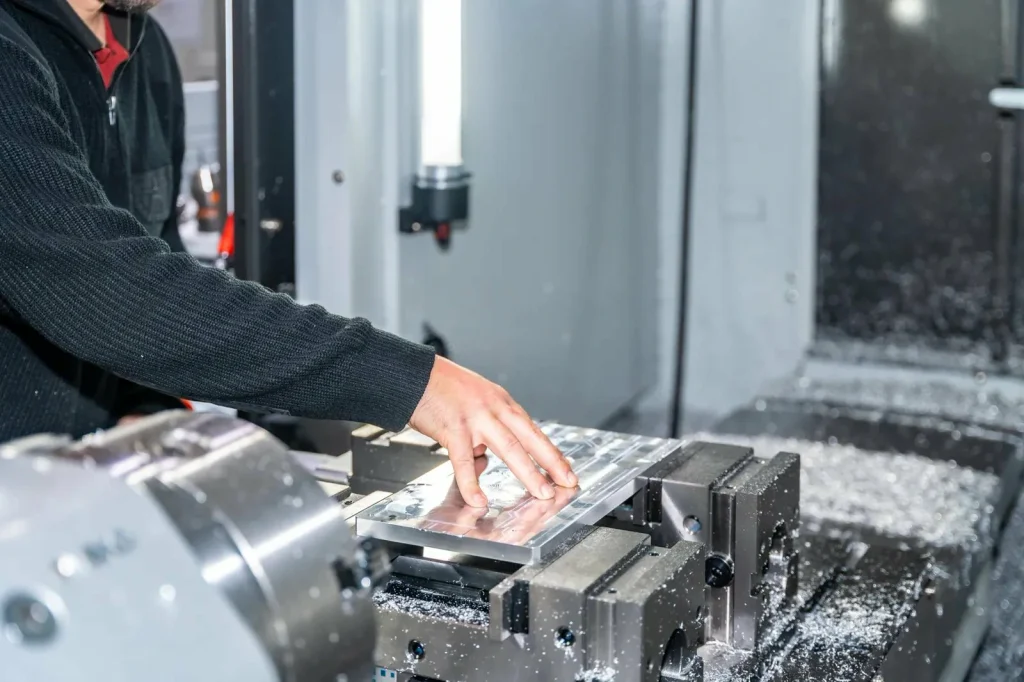
When workholding is poor, the symptoms do not always appear immediately. Instead, the damage accumulates slowly. A few extra minutes are spent aligning each part. A slight movement during clamping causes occasional dimensional variation. Operators compensate with extra checks and cautious adjustments. Some parts require rework. Others pass, but with more effort than should have been necessary. Over time, these seemingly small issues add up to lost hours, reduced output, and unnecessary stress on both people and machines.
One of the biggest hidden costs of poor workholding is setup time. In many machine shops, setup is one of the most expensive portions of the process because it consumes skilled labor without producing finished parts. If the self centering vise or fixture does not position the workpiece consistently, operators must spend more time indicating, adjusting, rechecking, and verifying alignment. That time may not show up clearly in cycle reports, but it directly affects profitability. A shop that saves ten or fifteen minutes per setup can create a meaningful gain over weeks and months of production.
Another major issue is repeatability. Reliable machining depends on predictable part location. If a part cannot be clamped in the same position every time, offsets may need to be adjusted more often, inspection results may vary, and confidence in the process begins to decline. Repeatability matters not only in large production runs but also in short-run and mixed-part environments. When setups change frequently, the ability to return to a stable and known position becomes even more important.
Dimensional accuracy is also closely tied to how the workpiece is held. Even a rigid machine and a precise program cannot fully compensate for poor clamping. If the workpiece shifts, lifts, tilts, or distorts under load, the final dimensions may fall outside tolerance. Thin-walled components, irregular shapes, and complex precision parts are especially sensitive to clamping behavior. In these cases, workholding is not just a support tool; it is part of the accuracy strategy itself.
Surface finish and tool life can also suffer when workholding is not optimized. A part that vibrates under cutting forces will often produce chatter, inconsistent finish, and unnecessary tool wear. Operators may respond by slowing feeds, reducing depth of cut, or using more conservative strategies than the machine is capable of handling. While this may help protect the part, it also means the shop is no longer machining at its most efficient level. Poor workholding can quietly turn a capable process into a compromised one.
There is also a training and labor dimension to consider. Many shops today face difficulty finding highly experienced machinists, and even strong operators need systems that support consistency under production pressure. Good workholding helps standardize the process and reduce dependence on individual technique. If a vise cnc or fixture positions the workpiece in a reliable and intuitive way, newer operators can achieve better results more quickly. That does not eliminate the need for skill, but it helps create a more repeatable workflow across different shifts and different personnel.
As machining becomes more advanced, the demands on workholding continue to increase. Four-axis and five-axis machining, for example, require not just secure clamping but also clear tool access. A bulky or poorly designed setup may force additional operations simply because the cutting tool cannot reach certain features efficiently. This reduces the advantages of multi-axis machining and increases the chance of error during repositioning. Compact, accurate, and stable workholding plays an essential role in unlocking the real value of these machine configurations.
The same is true for shops moving toward more modular or automated production. Quick-change systems, palletized setups, and standardized fixture strategies all depend on repeatable workholding. Automation does not tolerate inconsistency well. If part location varies or clamping reliability depends too heavily on manual adjustment, lights-out production becomes much harder to trust. In this sense, good workholding is not just about current production—it is also about future capability.
One common mistake in purchasing decisions is evaluating a vise only by its price. A lower-cost option may appear attractive at first, especially when budgets are tight, but the real cost of a workholding system cannot be measured by purchase price alone. If the tool creates longer setups, more inspection checks, increased scrap risk, or reduced machining confidence, it may cost far more over time than a better-engineered alternative. The true value of workholding lies in the process improvements it supports every day.
A well-chosen vise or fixture can create benefits across multiple areas of operation. It can reduce setup variation, improve part location, increase rigidity, support more aggressive machining, and help the shop move more smoothly from job to job. These advantages are often felt immediately on the shop floor. Operators trust the setup more. Engineers spend less time troubleshooting unpredictable results. Inspection becomes more consistent. Managers see better machine utilization. The improvement may begin with a simple clamping upgrade, but the results can extend throughout the workflow.
Choosing the right workholding solution begins with understanding the real application. Not every job needs the same approach. Some parts require maximum clamping force, while others need precise centering. Some operations demand compact access for multi-face machining, while others benefit most from fast loading and unloading. Material type, part geometry, tolerance requirements, machine size, and production volume all play a role in determining what will work best. The most effective shops do not treat all vises as interchangeable. They select workholding based on process needs, not just convenience.
It is also important to think beyond the initial job. A good workholding strategy should support long-term process stability. It should make it easier to repeat successful setups, document best practices, and scale production without introducing unnecessary variation. In a competitive market, consistency is often more valuable than occasional peak performance. A shop that can deliver predictable quality quickly and repeatedly has a stronger position than one that relies on last-minute adjustments and operator workarounds.
Ultimately, the hidden cost of poor workholding is that it undermines everything else. It limits the value of the machine, reduces the effectiveness of the tooling, weakens the reliability of the program, and increases the burden on the operator. Shops do not always notice this immediately because the losses are spread across many small inefficiencies rather than one dramatic failure. But over time, those inefficiencies become expensive.
That is why workholding deserves more attention than it often receives. It is not a secondary detail in the machining process. It is one of the foundations of quality, efficiency, and repeatability. A strong setup creates confidence. A repeatable clamping method creates stability. And a better workholding system can often deliver performance gains faster than many more expensive investments.
As CNC machining continues to evolve, the shops that succeed will be the ones that understand the entire process, not just the cutting cycle. They will pay attention to how the part is held, how the setup is repeated, and how every stage of the workflow supports better results. In that environment, workholding is not just about holding a part in place. It is about creating a process that is stable, efficient, and ready for the demands of modern manufacturing.
About the Author